
Diabetic Dyslipidemia: A Precision Framework for Risk-Based Lipid Management
DOI:
https://doi.org/10.69734/0xp63t08Abstract
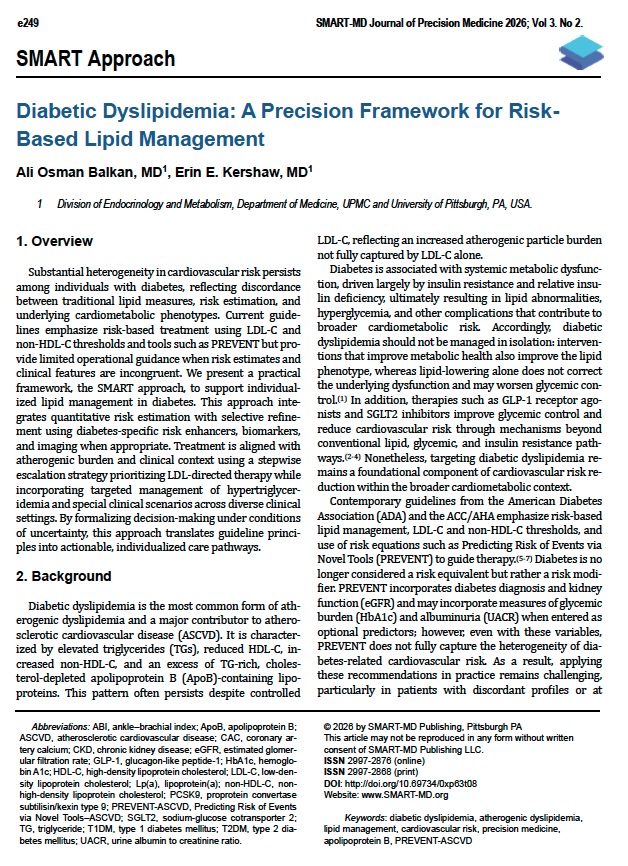
Atherogenic dyslipidemia refers to a specific pattern of blood lipid abnormalities that promotes atherosclerotic cardiovascular disease (ASCVD). It is defined by elevated triglycerides (TG ≥150 mg/dL), reduced high-density lipoprotein cholesterol (HDL-C <40 mg/dL in men, <50 mg/dL in women), elevated non-HDL-C (reflecting all ApoB-containing lipoprotein particles), and increased small, dense low-density lipoprotein cholesterol (sdLDL-C; even when LDL-C may be normal or near normal) on standard lipid panels (SLPs). Diabetic dyslipidemia is a subset of atherogenic dyslipidemia seen in individuals with diabetes mellitus (DM), diagnosed by elevated glucose (random ≥ 200 mg/dL, fasting ≥ 126 mg/dL, HbA1c ≥ 6.5%, or 2-hour OGTT ≥ 200 mg/dL). Insulin resistance (IR) is the most common underlying driver of this lipid phenotype and explains its frequent presence in type 2 diabetes (T2DM), pre-diabetes (PDM), obesity, metabolic syndrome (MetS), and polycystic ovarian syndrome (PCOS). Elevated triglycerides and low HDL-C are robust epidemiologic markers of future dysglycemia and ASCVD risk in IR states.
This SMART approach aims to enhance diagnosis and management of atherogenic dyslipidemia associated with IR and DM. It outlines a practical differential diagnosis with and without IR/DM, summarize current lipid management guidelines, and proposes a real-world, personalized treatment framework. Key clinical insights are also included to address common challenges in managing these patients.
References
- Berberich AJ, Hegele RA. A modern approach to dyslipidemia. Endocr Rev. 2022;43(4):611-653. doi:10.1210/endrev/bnab037
- Pirillo A, Casula M, Olmastroni E, Norata GD, Catapano AL. Global epidemiology of dyslipidaemias. Nat Rev Cardiol. 2021;18(10):689-700. doi:10.1038/s41569-021-00541-4
- Ramasamy I. Update on the molecular biology of dyslipidemias. Clin Chim Acta. 2016;454:143-185. doi:10.1016/j.cca.2015.10.033
- Blokhina AV, Ershova AI, Kiseleva AV, et al. Clinical and biochemical features of atherogenic hyperlipidemias with different genetic basis: a comprehensive comparative study. PLoS One. 2024;19(12):e0315693. doi:10.1371/journal.pone.0315693
- Berglund L, Brunzell JD, Goldberg AC, et al. Evaluation and treatment of hypertriglyceridemia: an Endocrine Society clinical practice guideline. J Clin Endocrinol Metab. 2012;97(9):2969-2989. doi:10.1210/jc.2011-32136
- Kelsey MD, Nelson AJ, Green JB, et al. Guidelines for Cardiovascular Risk Reduction in Patients With Type 2 Diabetes: JACC Guideline Comparison. J Am Coll Cardiol. 2022;79(18):1849-1857. doi:10.1016/j.jacc.2022.02.046
- Grundy SM, Stone NJ, Bailey AL, et al. 2018 AHA/ACC/AACVPR/AAPA/ABC/ACPM/ADA/AGS/APhA/ASPC/NLA/PCNA Guideline on the Management of Blood Cholesterol: A Report of the American College of Cardiology/American Heart Association Task Force on Clinical Practice Guidelines. Circulation. 2019;139(25):e1082-e1143. doi:10.1161/CIR.0000000000000625
- Diao JA, Shi I, Murthy VL, et al. Projected Changes in Statin and Antihypertensive Therapy Eligibility With the AHA PREVENT Cardiovascular Risk Equations. JAMA. 2024;332(12):989-1000. doi:10.1001/jama.2024.12537
- Writing Committee, Lloyd-Jones DM, Morris PB, et al. 2022 ACC Expert Consensus Decision Pathway on the Role of Nonstatin Therapies for LDL-Cholesterol Lowering in the Management of Atherosclerotic Cardiovascular Disease Risk: A Report of the American College of Cardiology Solution Set Oversight Committee. J Am Coll Cardiol. 2022;80(14):1366-1418. doi:10.1016/j.jacc.2022.07.006
- Khan SS, Coresh J, Pencina MJ, et al. Novel Prediction Equations for Absolute Risk Assessment of Total Cardiovascular Disease Incorporating Cardiovascular-Kidney-Metabolic Health: A Scientific Statement From the American Heart Association. Circulation. 2023;148(24):1982-2004. doi:10.1161/CIR.0000000000001191
- Joseph JJ, Deedwania P, Acharya T, et al. Comprehensive Management of Cardiovascular Risk Factors for Adults With Type 2 Diabetes: A Scientific Statement From the American Heart Association. Circulation. 2022;145(9):e722-e759. doi:10.1161/CIR.0000000000001040
- Winchester DE, Maron DJ, Blankstein R, et al. ACC/AHA/ASE/ASNC/ASPC/HFSA/HRS/SCAI/SCCT/SCMR/STS 2023 multimodality appropriate use criteria for the detection and risk assessment of chronic coronary disease. J Cardiovasc Magn Reson. 2023;25(1):58. doi:10.1186/s12968-023-00958-5
- Grundy SM, Stone NJ, Bailey AL, et al. 2018 AHA/ACC/AACVPR/AAPA/ABC/ACPM/ADA/AGS/APhA/ASPC/NLA/PCNA guideline on the management of blood cholesterol: a report of the American College of Cardiology/American Heart Association Task Force on Clinical Practice Guidelines. Circulation. 2019;139(25):e1082-e1143. doi:10.1161/CIR.0000000000000625
- Michos ED, McEvoy JW, Blumenthal RS. Lipid management for the prevention of atherosclerotic cardiovascular disease. N Engl J Med. 2019;381(16):1557-1567. doi:10.1056/NEJMra1806939
- Glavinovic T, Thanassoulis G, de Graaf J, Couture P, Hegele RA, Sniderman AD. Physiological bases for the superiority of apolipoprotein B over low-density lipoprotein cholesterol and non-high-density lipoprotein cholesterol as a marker of cardiovascular risk. J Am Heart Assoc. 2022;11(20):e025858. doi:10.1161/JAHA.122.025858
- Solnica B, Sniderman AD, Wyszomirski A, et al. Concordance/discordance between serum apolipoprotein B, low density lipoprotein cholesterol and non-high density lipoprotein cholesterol in NATPOL 2011 participants: an epidemiological perspective. Int J Cardiol. 2023;390:131150. doi:10.1016/j.ijcard.2023.131150
- Wilson PWF, Jacobson TA, Martin SS, et al. Lipid measurements in the management of cardiovascular diseases: practical recommendations—a scientific statement from the National Lipid Association Writing Group. J Clin Lipidol. 2021;15(5):629-648. doi:10.1016/j.jacl.2021.09.046
- Brummel K, Shah N, Stone NJ. Advanced lipid thinking prior to incorporating advanced lipid testing. Am J Med. 2019;132(11):1279-1284. doi:10.1016/j.amjmed.2019.05.034
- Berberich AJ, Hegele RA. Genetic testing in dyslipidaemia: an approach based on clinical experience. Best Pract Res Clin Endocrinol Metab. 2023;37(3):101720. doi:10.1016/j.beem.2022.101720
- Brown EE, Sturm AC, Cuchel M, et al. Genetic testing in dyslipidemia: a scientific statement from the National Lipid Association. J Clin Lipidol. 2020;14(4):398-413. doi:10.1016/j.jacl.2020.04.011
- O'Sullivan JW, Raghavan S, Marquez-Luna C, et al. Polygenic Risk Scores for Cardiovascular Disease: A Scientific Statement From the American Heart Association. Circulation. 2022;146(8):e93-e118. doi:10.1161/CIR.0000000000001077
- Wiggins BS, Saseen JJ, Page RL 2nd, et al. Recommendations for management of clinically significant drug-drug interactions with statins and select agents used in patients with cardiovascular disease: a scientific statement from the American Heart Association. Circulation. 2016;134(21):e468-e495. doi:10.1161/CIR.0000000000000456
- Singh IM, Shishehbor MH, Ansell BJ. High-density lipoprotein as a therapeutic target: a systematic review. JAMA. 2007;298(7):786-798. doi:10.1001/jama.298.7.786
- Galimberti F, Casula M, Olmastroni E. Apolipoprotein B compared with low-density lipoprotein cholesterol in the atherosclerotic cardiovascular diseases risk assessment. Pharmacol Res. 2023;195:106873. doi:10.1016/j.phrs.2023.106873
- Ramjee V, Sperling LS, Jacobson TA. Non-high-density lipoprotein cholesterol versus apolipoprotein B in cardiovascular risk stratification: do the math. J Am Coll Cardiol. 2011;58(5):457-463. doi:10.1016/j.jacc.2011.05.009
Downloads
Published
Issue
Section
License
Copyright (c) 2026 SMART-MD Journal of Precision Medicine

This work is licensed under a Creative Commons Attribution 4.0 International License.
 Journal information